
Category Archives: Rapport

Rapport: The Link to Gaining Cooperation

Or, “Stuff They Never Taught You in Driver’s Training”

By Daniel Robin

A friend of mine once said that driving in heavily populated parts of California is like being on heavy sedatives while simultaneously having an adrenaline rush. For many of us, the traffic patterns in industrialized regions are a lot like how we get things done in corporate bureaucracies: “hurry up and wait.”

The metaphor of highway traffic serves to explain a lot of why working with others produces the desired results only when we move at the right speed, at the right times. This article identifies strategies to build an autopilot communication system for increased rapport with all types of people. The result is that we’ll get things done faster, with less effort, and maybe even have more fun along the way.

As we drive around town or try to navigate on the “information highway” upon which so much of our work depends, we may ask ourselves, how is interpersonal communication like highway traffic? When communication works, like patterns of traffic, we flow in ways that get us to where we want to go, and we often don’t even notice how we got there. It’s when we must get somewhere and flow doesn’t happen that it grabs our attention. Effective communication, just like driving a dangerous and curvy highway, is all about cooperation and managing the flow.

Let’s go one step further. What would it be like if every time someone badly misinterpreted what was going on around the office, we saw skid marks on the carpet, coffee spilled everywhere, and smashed desks and chairs piled in the corner? If we could only see our communication breakdowns before they occur ….

How to Avoid Bashing Into Things

When we feel pressured or we get uptight, we tend to narrow our peripheral vision, withdraw our senses, and we forget that communication, like traffic, is a cooperative system. When communication matters most, where do we put our attention? Our peripheral vision, ability to hear subtle cues, and our body acts as an early warning system, and can help us carefully and skillfully avoid bashing into others.

When we put our full attention on the other person (or group), that’s Step One in maintaining rapport and flowing with them in collaboration. Of course, before establishing that link, know your goal, know your purpose in being there, know what you want out of the conversation. Then you can fully shift your attention to them, and trust that you’ll somehow end up where you need to be.

The Magic of Rapport

Rapport is the condition of being in sync, in tune, on the same wavelength. I’ve heard it said that with enough rapport, anything is possible; without rapport, practically nothing is possible. In business, rapport is needed to coordinate action and exchange information. Rapport is at the foundation of all our relationships. Ironically, most business decisions are based on rapport, not on technical merit or the best idea. Rapport makes or breaks most aspects of getting what you want.

How much rapport do you need? Depends on your goal.

To maintain an open channel of communication with another person is to align with them, match them, meet them where they are. This doesn’t mean you agree with them, necessarily, but rather that you are open and willing to accept their point of view and you let them know you’re there with them.

Try this experiment. Think about someone you know who is very much unlike you. (Use a troublesome co-worker if you can’t think of anyone better.) Can you imagine yourself matching their basic mood, posture, body language, energy level, tempo, and world view? How would you look and sound if you were like them? Try this next time you are in a conversation with this person. Pick one or two aspects of their behavior, like their voice tone and tempo, and duplicate it. Say things the way they do. Sit and move as they do. They won’t notice that you’re being like them — people only notice differences.

After you’ve done that for a while, practice matching their vocabulary, their apparent mood or underlying values, their posture, or their breathing. Are these more of a challenge? Matching does not have to be direct. Crossover matching (using a different side or other body movement, not to be confused with cross dressing) can be as effective and more subtle. By practicing this periodically for several weeks, it becomes even more automatic, and you will fall into step with others more quickly and easily.

Consumer protection warning: If you match or “pace” people long enough, you’ll start to like them!

The purpose of this approach to building rapport (matching and aligning with the other person) is to get fully in step with them, so that the next step you take, they’re more likely to follow. When you start by matching and meeting them (not expecting them to come to you), you can take immediate control of the situation and move with greater confidence that they will stay with you. Worst case, matching gives you something to do when you get bored during staff meetings.

The next section takes rapport-building one step further: defining the meaning of your communication, and shows how behavioral flexibility strengthens your power to influence and persuade others.
Turning Opposition to Understanding through Aikido

The Reactionary Tango

By Daniel Robin

Communication is like a dance … when it works, there’s a blending and cooperation that requires awareness and skill. Fortunately, only one partner needs to be skilled (though it takes lots less work when both are).

We all bring expertise at some of the “dance moves” of interpersonal relating. Some people hate chit-chat, while others can’t seem to get to the point. When does your personal communication style work, and when does it get you unintended results?

Unlike dancing, however, business communication always holds a purpose beyond the dance itself. Whether your partner is a communication klutz or happens to be a powerful negotiator, learning new steps allows you to realize that purpose smoothly, with minimal toe-tromping.

Waltzing with the ‘Enemy’

When the other person gets inflammatory with “If you don’t start putting in some effort here I’m going to …,” or “I’m sick and tired of you always …,” or “I told you …,” how do you react? Do you suddenly feel like they’re doing raggae while you’re trying to swing? Whose problem is it?

Even if you feel attacked, you can “release” your enemy stance by not getting caught up in the attack, by not getting hooked into a dance you’d rather not do. How? Don’t react, respond with a remarkable dance step borrowed from the martial art of Aikido.

It works like this: Notice at what point you are being attacked. Let’s say they’re out to make you wrong. Rather than struggling with the apparent focal point of the attack from defensiveness, polarity, or as their adversary (“I think I’m right …,” or “You don’t know what you’re talking about …”), move off the line of the attack and join shoulder-to-shoulder with the attacker. You might reply, “I don’t think so, but let me look at it from your point of view,” or “I’m interested to learn why you think so,” or even “What’s your intention here? And what would that do for you?”

A Modern-Day Hokey Pokey?

Metaphorically, if the attacker just grabbed your arm, rather than focusing on the arm (the issue or the point of attack, where moving your arm would cause a struggle), instead, leave the arm alone and pivot your entire body alongside the attacker’s arm. From this position, you are out of the way of the direction of the attack, and in an excellent position to use the attacker’s energy. You are literally seeing the attacker’s point of view from its source, and therefore in an ideal position to avoid escalation and resolve the conflict.

Even if you’re not being attacked per se, this approach can be used to leverage the other person’s interests, intention, motivation, anger or resistance to find a mutually satisfying outcome.

I’m Sorry, but I Wasn’t Listening

Doesn’t it seem like the world has become very noisy? Not just shrill ringtones, 911 sirens, and other signals that we live in a so-called civilization, but more the continual assault of daily information, spam and social media (if you find the benefits outweigh the BS) — it’s no wonder we often stop listening to ourselves and to each other. Even with the awareness that our health requires us to understand and be understood by the world around us, we sometimes forget how powerful it is to give someone our ear.  AI is not going to be helpful in this regard — it is really just an echo chamber and illusory.

When your goal is to get your own point across, the first and most important move you can make is, ironically, to listen. Clients report that it “works like magic” to get on the other person’s “wavelength” by gently drawing them out. Just the intention of understanding them first creates an opening that Dr. Stephen Covey first popularized as “seek first to understand, then to be understood.”

This interpersonal principle is an extension of “when you want something, give it.” Proactively make that first move.  If you want a receptive ear on the part of your listener, be one first. If you want a new car …. well, that usually requires a different kind of resource.

So that explains why to listen, but listen for what? Listen how? In the book Getting to Yes, authors Fisher and Ury state “It is not enough to know that they see things differently. If you want to influence them, you also need to understand empathetically the power of their point of view and to feel the emotional force with which they believe in it.”

That powerful, disarming, catalytic.  If you can get their “truth” out on the table, the psychology of negotiation says that they’ll have no better option than to listen to you, to reciprocate.  Unless they are completely out to lunch, not operating on good faith at all, this is how you take the “dance” to a whole new level, disrupting push/pull patterns of the past, and set a new standard by demonstrating what mutual respect can accomplish.  At least for that interaction.

Armed with the awareness that you don’t have to agree to understand, and you need not understand to accept their view, have your next interaction(s) bring out the martial artist that lives in each of us.

Helping the Emergence of Co-operative Work

By Daniel Robin

Whether you’re a group manager or executive, member of a dedicated work team, or an entrepreneur out on your own, you’ve probably noticed an increased reliance on collaboration and co-operation to get things done. The days of the lone wolf or the aggressive, cut-throat bully are over. Effective managers have realized that treating people as mere factors of production isn’t very productive.

Yet, despite the importance of having whole human beings showing up for work, most organizations still talk of empowerment but struggle to achieve it. Step one: commit to building a culture where people at every level are given the tools and training, the skills and strategies, the authority and responsibility needed to share power, build trust, and get recognized. Once the commitment has been made, don’t say much about it, just make it happen collaboratively and highlight the results as evidence of the commitment.

Letting Go of Control

Leaders of hierarchical organizations have resisted “handing over the keys to the car” because they’re not sure if we can drive. The task is to let go of control in favor of new structures and agreements. Be gone layered hierarchies built on information, bureaucracy, and power over others; welcome instead structures that help transfer knowledge and pertinent performance data to those who need it. Letting go is perhaps the hardest change there is, one that often elicits fear, anger, and ambiguity. That may explain some of the chaos and uncertainty of late.

The problem with upper management’s ambiguity is that it can look and smell like a trick, like yet another power trip — and people can mistake it for insincerity and claim to “smell a rat.” Fear and incongruence ain’t pretty. If people pick up a message of false empowerment (“You are now empowered. Trust me on this. Now get back to work.”), when the laughter subsides, cynicism remains to fill the gap left by the empty promise.

Building a Trust Culture

Even when employees are given all the power and responsibility they can handle, management’s motive is suspect: the “gift” seems conditioned on improved performance (guess what: it is!). This equal treatment must be acknowledged as a right, not a privilege, not something with strings attached, as if the cars keys can be yanked back for the slightest infraction.

At the core of this changing employment contract is an unspoken promise: “You handed us the new gameplan, now coach us to play the game.” This means that new skills and structures must displace the old autocracy. The role of management is changing from managing others to providing an environment where people can self-manage.

To make the shift as smooth as possible, people in team-based organizations are learning how to provide such an environment with coaching.

The Art and Practice of Coaching

Similar to a sports coach who aims to bring out an athlete’s best performance, coaching in a workplace setting helps guide people to their own answers, making “empowerment” a reality.

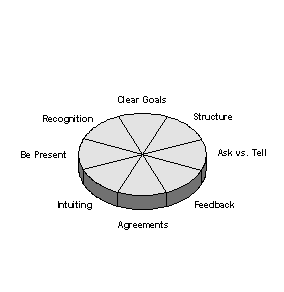
We’re often asked what constitutes coaching versus other styles or approaches. From the viewpoint of the person doing the coaching, there are eight essential elements that, taken together, differentiate coaching from other methods, like teaching, consulting, or counseling. The elements are shown in the wheel below:

1. Be present: Before coaching someone, pay careful attention to the signals that indicate rapport. The more you can be present, the better you will be as a coach. It would be a mistake to push through resistance or to coach when you are distracted. Instead, being present means being on their agenda, available to what they’re up to, able to let them know you understand their situation, challenges, resistance, fears, etc. Like rapport, this element is foundational to all others.

2. Clear Goals: Assuming that you and the client are clear on what’s wanted would be a mistake. Set clear immediate goals and long-term direction with “What do you want?” and “How will you know when you’ve got that?”

3. Ask vs. Tell: Giving unsolicited advice is not only disempowering, it’s unnecessary. Resist the temptation to “give them a fish;” instead, teach them how to fish for their own answers. If you feel compelled to offer advice, it can be packaged in a way that puts the person fully at choice and in charge. For example, try “I have an idea that you might find useful; mind if I check it out with you?”

4. Agreements: Unclear or incomplete agreements produce misery and suffering. “Oh, you thought I meant this Thursday!?” This also includes effective agreements for how they want to be coached. Clear agreements can contribute to setting an atmosphere of mutual respect and shared power. Effective coaching turns up the volume on accountability to agreements, replacing the need for “command and control.”

5. Recognition: Being present provides some recognition, while verbal acknowledgement builds the client’s enthusiasm and positively reinforces what’s working. Warning: Do not fake praise. The skill is in finding out what it is about this person and their performance that’s praise-worthy; be sincere and generously encourage what’s wanted.

6. Feedback: Let their mistakes be their best teacher. Live by “no failure; only feedback” and only give constructive suggestions for improvement. Learn to gently confront areas that need attention. Separate the person from the issue. Provide both observation and interpretation so you can openly discuss differing perceptions.

7. Structure: Instead of allowing fire-drills and chaos to rule the day, design reasonable action steps to reach achievable goals. Structures are for supporting, not burdening, the client. They assist the client to remember their commitments, to systematically assess and adjust priorities, to increase their capacity to focus, and to track progress for on-going learning and process improvement.

8. Intuiting: The opposite of structure. Note that intuition is different from opinion or interpretation. Intuition usually comes from a “gut feel” or other body signals. An effective coach knows when to throw away the plan, be pragmatic, and how to politely invade or challenge the client’s assumptions to prevent catastrophe.

Most high-functioning people already possess skill at coaching — they just need to understand how and when to use those skills to build trust with the client. Managers and team members gradually add new coaching skills and distinctions to their interpersonal repertoire.

The ultimate goal is to condition the client to use their own resources when you’re not around. And if you think being coached feels good, check out being one.

Advantages of Coaching

For the Coach

× Better employee performance

× You don’t have to have all the answers

× Shared responsibility, which frees you up to innovate, focus on building relationships

× Unleashed creativity

× Agreements upheld more often

For the Client

× Better results with less effort and less stress

× Employee feels more intrinsically motivated and in charge

× Increased commitment to doing their best

× Increased self-esteem and confidence

× More creativity and support for innovative problem-solving.