
Category Archives: Handling Differences

Trusted lies and the meaning of money

Recent reporting in the US indicates that we have accepted, as a culture, a “new normal” of half-truths and blatant disregard for facts.  Seriously?  Yes, unfortunately, this is no lie.  I wish I were kidding.  Apparently, some will consider this is a virtue, a victory over the rule of law, reason, and unadulterated honest dealings. It isn’t.

Repeated lying, especially the “rinse, wash and reTweet” kind, eventually has its comeuppance.  Drawing back the curtain of truth to reveal a squishy, truthy, ambiguous and slightly “magical” land, a universe where you can tell anyone that facts are for people too weak to imagine being a stronger, more confident leader?  This has gone too far.  The “Emperor’s New Clothes” may fit to a tee, but that’s still the ugliest suit I have ever seen!

But how do you reckon with “charming” liars who tell you what you want to hear, even (especially) if it doesn’t happen to be true? Humans are believed to have a predisposition to “situational” lying. The situation did it to me, make me do it, thus I cannot be held accountable.  Who makes up this stuff?  Apparently, some of us do, on a regular basis.

Being one’s word has to be more than how we feel in the moment.  Sure, we all have occasional lapses, but true strength comes from having the integrity to clean up a misdirection before it turns into a mess.

Speaking of messes, there is tremendous social pressure to “believe” what others tell you, if you wish to be accepted.  The need to belong or “affiliate” sometimes overrides the more rational and ethical part of the brain.  It is a powerful opiate.  This may be explain why there are those who buy into wild conspiracy theories that the rest of us know are not true, or at least such shared beliefs are so implausible (take QAnon for example) that there’s little reason to even check sources. Or how about whether or not Coronavirus was invented in a lab?  I guess you’d have to ask the lab managers.

We say an idea is a conspiracy theory when we want to completely discount it and to discredit its speaker.  People on both sides of the current US political polarization fall prey to a long list of bat-shit-crazy views, mostly a form of “group think” that is reckless, dangerous and often just sad.

Do we need to start a massive re-education program on critical thinking, the rule of law, and how science and other evidence-based practices can help quell the disinformation channel?  Unfortunately, no such luck.  It wouldn’t help because there are unexpected benefits of buying into conspiracy theories that seem to outweigh the risk of reputation loss or to being seen as mentally disturbed.  Those who entertain and ultimately buy into such theories are now part of our culture, too, pushing rights to free speech to a place that has only recently begun self-correcting.

Further, the tone of discourse on this topic tends to be highly combative, no doubt out of righteous anger and frustration with those who follow those pesky little things called facts, or those (some would say) that think for themselves, not as the media wants them to think.  That seems to include both those who lack imagination — and need to assume things are not as they appear — as well as those who apparently have too much of it.

“Coming together is a beginning.
Keeping together is progress.
Working together [skillfully] is success.”
                                               – Henry Ford

For my part, I can no longer gaze upon this world gone mad, where science is just an “alternative” set of facts to the “truth” that others see, and expect it to end well.  Even during times of crisis, observing more than one set of facts with dispassion is like some rubber-necking motorist witnessing a slow-motion train wreck.  The moral detritus is piling up, and the highways and byways of truth are clogged, choking and sputtering on the accumulating BS, even as the economy (once called the “global casino” by Fritjof Capra, now the title of a titular book on human-caused environmental issues), immune to what people think, has begun to find its “true calling” or higher purpose in several opportunities that deserve our full and unequivocal support. Money doesn’t care.  So we have to.

Since this column is about business, I’ll now navigate away from politics to discuss the more important realm of money and meaning, supposedly the reason many of us choose to work in the first place.  The political overlay is about context and how we treat each other.

Money & Meaning — what’s the cost/benefit of making a buck?

The purpose of money is not merely to perpetuate itself to make more of it.  To many of us, making money is, by itself, devoid of meaning, so we must ascribe to it that which we find meaningful.  We make it up.  What has meaning for you?  What matters most?  Second most?  I often suggest that any journey include at least three ways of measuring success.  This will usually (if done right) reflect cherished values and principles.

If our values allow us to pursue wealth and luxury for its own sake, just to have wealth, or to be wealthy, no matter the means, then that outdated view of capitalism explains the unruly game that gets played in many circles.  But what of human relations?  Do we wish to stay inside this circle and only trade with those who will uphold a money-focused “ethics free zone,” or would we prefer to find richness, beauty and fulfillment in a wider circle, one that which includes those that may sharply differ from our own worldviews, but are nonetheless interested in mutual respect, dignity, and wholesomeness?

I guess the question reveals my bias … yes, there is a right answer, but maybe it is not so simple.

Now I’d like to use the current US “political theater” to highlight a few salient points.  The clogging arteries of “truth and justice” do not end well for anybody, so we are starting to see an expose’ on “the game,” from both a linguistic and humanistic perspective.  I’ll add my two cents to the mounting literature, some of it pleading, occasionally moralizing (if there is a choice of taking the “higher road” to a flourishing life, wouldn’t you take it?), because in my view, we simply cannot continue like this, socially distant, for now, but worlds apart.  Enough is enough.

Is changing one’s mind a sign of strength or weakness?  Yes.  I mean, No.

A huge insult in politics is to call someone a “flip-flopper” and yet changing positions (based more on new information, or dawning awareness, not just political convenience) has become part and parcel of rewriting history, an attempt to “reframe” reality, to bend it, as some sort of a revisionist’s dream, stating and restating the world as we wished it were.  As if the current position is the only one that matters and nothing that has come before matters?  Admittedly, the American public has a short memory span, made even shorter by Twitter and other top-of-the-trees reports and voices that would like to matter.  But to neglect recent history in favor of the one preferred by a determined group is just another deception that must be rejected.

Remember the saying, “If we knew better, we’d do better?”  Guess what?  We know better.

I once had a mediation gig in Kuwait.  It was a very entrenched dispute that had gone completely off the rails.  Every day, for nearly 3 weeks, the parties agreed to put their differences aside and declared a new day.  This was inefficient, at best (although at that point it was the all they could do to show a willingness to restart talks without losing face).  Later we did manage to talk about the past and learn from it, and go on to finish the project, but even with strained relations, business leaders must reject the tendency to cast aside all prior results and plans in favor of a “new day.”  The enterprise’s history and team’s core values must inform decisions starting today.  What’s the hype versus what’s the hope for a shared future?  That’s a conversation worth having!

Lying certainly can have an upside (some claim that such manipulation is good for your career), buffer our relationships, provide excuses for someone to temporarily feel safe with their own truth. We often lie to ourselves, and who hasn’t tried to get away with a so-called white lie here and there? That doesn’t necessarily make you a liar or a bad person. Not knowing how people lie and twist the truth could set you up for being blinded when someone else does it, but that isn’t an endorsement of crime as a way to catch criminals either.  Learn how to handle your own fluctuating emotions and need for ego gratification without taking others prisoner. This is what responsible adults do.

Energy Conservation Starts at Home

The corporate mindset of the media made a big deal about Bill Clinton’s affair(s) because they could.  We see this ‘smear job’ (tongue in cheek) of attack-and-defend tying up a huge amount of energy in the political sandbox — nothing more than drama born of win-lose thinking — energy that could instead be used for getting on with the real work of improving the sandbox.

What is presently just a distraction begging for you to take the bait (yet again), the monkey chatter in the leaves of the tree (Twitter still has a lot of it, as does all social media, even if they’re recently growing something akin to a backbone) versus the more important question, “what about the trunk?” What do we wish to grow?  How will we grow?

The Wizard of Oz invited us to not be distracted by the man behind the curtain.  Why do such illusions often seem so real, and why do we keep falling into the trap of getting hooked by the drama of opposition or of adversarial alliances?  It is one of the oldest distraction techniques on earth.  Sun Tzu‘s “Art of War” was published before any of us were even born, and yet it continues to play on our humanity, our vulnerability, our darker tendencies?  Its called shadow.  We all have one.

How to rise out of that conundrum and into the light?  Be sure not to get caught up in fear.  The antidote to fear, a similar experience in the body, is excitement and audacious assertiveness (“a willingness to take surprisingly bold risks”), but doing so skillfully and respectfully. Why?  Because we can’t easily minimize or eliminate fear, thus better to maximize our audacity … with integrity, honesty, and skillful presentation to the right people, asking until … [we reach our goals], acting as if we have nothing to lose (because we don’t, in that context), building confidence in our better offer, building character, and honing our core selves.

Even if democracy takes a serious body slam among the way, at least we’ll be better humans, worn smoother around the edges by the friction caused by our respectful audaciousness.

I’m writing all this in hopes of ensuring that this situation, longer-term, doesn’t drift into an unrecoverable lose-lose dynamic for all us stakeholders.  Short of believing in miracles, we seem to be heading down the road of fewer options than normal.  A 2-party system is becoming a no-party system. Narrowing our choices because we’re uninterested in booting and using the part of the brain that involves reason, reflection, or funny little things called facts must not become our de facto plan.  That’s worse than having no plan.

3M’s — Manipulation, Misleading, and Masquerading

A recent transaction with someone in West Africa supported the value of American politics admitting that they liked the “all action, no talk” approach.  That is hardly what we want to teach others, and behavior role models are what we Americans (and others in the developed world) offer, by silent default, unless refuted, or cast out.  I cannot condone such mindless and corrupt reasoning, so let’s talk about these three M’s and then define the higher road.

M1:  Manipulation:  “I know you are but what am I?” is the childish ploy of turning the table on the schoolyard, employed regularly by master manipulators.  Point-by-point comebacks that set the record straight are rare but necessary.  This is the art of war and getting one’s message across.  “Crooked Hillary” and Lying Ted Cruz are examples of manipulation in the last election that became memes (spread on their own) cannot displace facts to the contrary.

M2: Misleading information about elections being hacked or corrupt just don’t line up with the facts.  Spreading an effective lie (so that it travels well enough to “infect” millions of others, as thought-viruses often do) is still lying.  Our ability to survive and thrive as a nation depends on regaining our sense of what is real.  It may take a long time to get over this past “race to the bottom” with so-called fake news, hyper-partisanship, and polarized “enemy stance” … mutually assured destruction, but it must be carried in the minds and hearts of every American, even as the “tribal warfare” unfolds.  Things have gotten far too bad and it is far too late for cynicism.

The US has been in the de facto leader on many fronts (though lagging behind in some areas, such as protecting the environment) for decades.  More recently, we began “exporting” an unfortunate byproduct of our bipartisan politics:  the belief that action is more important than truth.  That if you act strong and appear to be decisive (even if resultant policy decisions are entirely wrong-headed) somehow that is more important than the nuance and care required to live according to one’s principles?

If greed is all that matters, and the end justifies the means, then take everything, leave nothing but a trail of betrayal and scorched earth, and be sure to never apologize, admit one’s mistakes, or learn anything.  That sort of self-reflection is for the weak.  What kind of leadership is this, exactly?

M3:  Masquerading:  Instead of masquerading for effect, or playing the role seemingly required of us by party, church, the boss, spouses, etc., how about if we show up as our authentic selves?  I know this sounds simplistic, even somewhat outrageous to suggest, but as written above, and in a business plan recently, “Audacity has to outpace fear.”

Stand up, Put people in their place, Set boundaries

The race to the bottom has finally arrived.  We made it!  So now what?  Instead of planning another attack on democracy, or on each other, what we can and must do is uphold our respective areas of mutual respect, set the tone, but don’t be “nice” about it, be real.

The meek may yet inherit the earth, but will they want it?  And would they have the nerve to step up to the podium and accept it?

Thanks for listening/reading.  Respectful rebuttals are encouraged.

Daniel
Alignment

Lack of alignment around goals, or the deeper challenges of disagreements about priorities, the desired future, beliefs about what is possible, let alone worthwhile, sometimes fueled by egoic, dysfunctional, win-lose thinking, all limit success.
When stakes are high, this lack of alignment can create quite a mess.  Though recovery from such setbacks isn’t usually a problem, if there’s a preventable pattern, or perceptions that the misalignment is between management and workforce, it can be demoralizing and distracting … a quiet productivity killer.

From Mess to Success

Key questions:

1.  How can differences be turned into competitive advantage?

Significant differences are, by definition, the key to synergy (1+1=3), innovation and change.  If each collaboration partner brought the same information, style, values and priorities, awareness and so on to the table, one or more of them would be redundant. Key is to harness these differences and use them toward agreed-upon challenges, critical success factors, strategic innovation and important goals.  We often get caught up in managing differences that don’t matter or deserve the attention they get.

2.  Do we use collaboration at the right times?

Although we sometimes invest face time or too much of our agendas to things that don’t deserve it, we also can’t just ignore fundamental differences, and push and drag each other around in resistance.  Some cultures do this all day long, but it is exhausting and ultimately not productive.  Effective collaboration seeks solutions or helps participants put differences aside to focus on the real prize — the innovation that can result when teams are aligned in their purpose.

3.  How can individuals work autonomously, with their own authority and sense of power, without simply withdrawing from friction in relationships?

Many of us do not have a positive association with of resolving differences or have a fear of confrontation.  Often, just as common ground is beginning to emerge, collaboration partners give up on a project or step back from a key relationship just because there are differences or apparent conflicts starting to crop up.  This is about confidence, standing one’s ground, but being flexible enough to stay in the conversation until solutions can be put in operation. 

Alignment happens, but just as often, value is lost and worthwhile projects or initiatives languish.  What are your workplace culture’s standards and does everyone operate accordingly?  If not, what steps might you take?

4.  How can incentive systems, innovation platforms and other change initiatives reward skillful handling of differences?

Incentive systems that provide external rewards are sometimes seen as manipulation; intrinsic motivation to perform and get results in diverse teams can be a powerful drive of change — so long as functional areas are aligned on goals and required to row in the same direction.  Allowing for diverse points of view can be stimulating, but tapping into the potential value in that diversity takes practice and skill.  Modeling this behavior is more effective than espousing it.

5.  What enables leaders and key contributors to harness differences toward lasting value?

The assumption that people are “walking bundles of strengths” and a desire to find the useful parts of what others think and know, not just differences that don’t happen to fit with what’s familiar or seeming to be the “right answer” based on first impressions.  In other words, patience and curiosity without losing sight of bigger picture goals.  This more inclusive style, within clear structure about the rules of engagement and incentive systems, plus skillful communication, will yield positive results.  If not, contact us to help diagnose what’s getting in the way.

Related article:  Seven Attitudes to Dissolve Conflicts

Related topics:  collaborationhandling differences | agreements | rapport | resistance

Anger Management Self-Assessment

How often do you find yourself using these five strategies for dealing with anger?

Rate each statement on the left using a scale from 1 to 10 (1 = never, 10 = every time):

Score

Approach

Increase

Decrease

DIRECT: I get angry and decide to “go off” (express anger or the fact that you are angry) right on the spot.
REFLECTIVE: I take time to reflect on the source of what upset me before doing anything.
ACCEPTING: There are times when I experience anger or frustration that I can consciously choose to release, deliberately letting go of it.If you’ve ever had a time when you wanted to let it go but it wouldn’t leave, what did you do then?  (hint: see the next two options below)
CONFRONTIVE: After reflecting on the source of what upset me, I deal directly and skillfully with the person or situation that caused my anger.
SIDESTEP: I use healthy outlets for expressing anger – instead of directly addressing the person or taking it out on the people around me (e.g., sports, exercise, screaming in the car, chopping wood, hitting pillows or other inanimate objects,…).
OVERALL: My normal emotional state is peaceful, calm and centered. I do not carry around “habit anger” (unfinished business); I maintain my cool.

Now take a look at your scores.  If there’s one that is particularly higher or lower than the others, use the boxes at the right to indicate the approach to anger you’d like to increase or decrease.  What would you like the score to be?  How will you practice?

Feel free to print out this template for future reference.

Difficult Behaviors at Work: Part 3

I Hate It When You Do That! (Do what?)

By Daniel Robin

Dealing with difficult people (or, more precisely, consultant-speak “behavior”) begins with identifying and naming that which is so exasperating – you know, the types of behavior that drive you nuts, that trigger a strong reaction in you.

Think, for a moment, about the people around you, and notice any behaviors that push your buttons. What’s “difficult behavior”?  Actions, or inactions, that seem less-than-helpful, or that get under your skin.  I offer the following list of behaviors that commonly set people off. It is by no means comprehensive, but may serve to remind you of the patterns you experience at work.

After reviewing this list, circle up to three that hit home strongly for you. Or write examples of some that do.

Which Behaviors Fry You?

  1. PWBA – “person with bad attitude” – complains constantly, blames others, exhibits negativity as if a victim of circumstances, with no apparent interest in taking responsibility.
  2. Space Invaders. People who “invade your space,” seem to not notice implicit social boundaries, who assume you want their (unsolicited) advice, or who try to “fix” you without checking to see if you think you’re in need of repair.
  3. Knee-jerk Resisters. People who polarize automatically, who oppose new ideas or outside influences without listening, take a contrary view without considering objective facts or other relevant opinions.
  4. Permanent Hijacking. People who wear anger like a habit – moody, edgy, hostile, or aggressive … even when they’re not upset about anything in particular. Often this hijacking is paired with aloof passivity (also called passive-aggressive).
  5. Ruthless Critic. Being harshly or tactlessly critical; picky, perfectionistic … for whom nothing is adequate, nobody and nothing is enough.
  6. Verbally Compulsive. Overly talkative types who want to “process” everything, for hours, when you just want to get on with it. Which reminds me of a story … you know, the other day ….
  7. Avoiders – people who seem to go out of their way to avoid confrontation, prefer to keep things vague, indirect, refusing to be pinned down to a commitment.
  8. Accommodators – folks who say “yes” to keep the peace or who withhold their honest perceptions, while in truth they don’t agree at all.
  9. Authoritarian bullies who compete for the one right answer, are “seldom wrong but often mistaken,” who condescend, sometimes treating others like children, or blow up and hurtle insults, curse, yell, etc.  Usually, they have no awareness that they are doing it.

What pushes your buttons? What did I miss? Consultants that provide long lists of annoying behaviors then ask “What did I miss?” Makes me mad, too.

Getting to Change

Here’s how to lead toward change while avoiding becoming “difficult” (1-9 above) yourself: separate the person from the behavior. On the one hand, how they act drives you crazy. And from their perspective, what are they trying to achieve that’s worthwhile? No idea? Good starting point.

It may be hard to believe, but just like you, the person behind each of these difficult behaviors has a positive intention. That intention may be completely separate from the result they are getting, but it’s there. Look for and identify it, and then you can talk about alternative approaches that will work for both of you. For example (Ruthless Critic): “I can see that you are trying to contribute to the project, and for me, it works better when you talk about what you liked before you dig into where you see room for improvement.”

If you don’t know what the person is trying to achieve, ask. They’ll know. “I notice that you X, … what is that intended to do?” Or simply, “What’s your goal [with that behavior]?” … and then “What will that do?” Sure enough, you’ll hear what they thought you knew all along … their positive purpose!

Sometimes there’s a tradition of enabling or allowing a difficult behavior to continue because nobody has a clue what the person is trying to achieve. All anybody can see is the “problem behavior” which grows and grows until there’s a seeming monster in the room (formerly know as your colleague, boss or co-worker). What was once something you probably found just annoying or mildly disrespectful becomes harder to distinguish from the person’s valuable core – where they are successful, their unique genius, or irrefutable strengths. Moral: intervene early and keep current. Don’t build a deficit economy out of your emotional bank account with that person or group.

When to Obtain Outside Assistance

In cases involving groups that are volatile or emotionally charged, another option would be to ask management or a neutral outsider to step in and meet with the group to clear up “how we work together.” This is no substitute for one-on-one coaching, but at least this can give a heads up about “bothersome” behaviors to avoid creating a hostile or threatening work environment. Perhaps put in writing the agreement that everyone has been asked to uphold, and ask for signatures to acknowledge their understanding and cooperation. This sets the tone and also helps protect the company legally.

The important thing is to keep the communication channels open. If you can discuss the behavior when it is just beginning to turn into a pattern, you can speak plainly and directly to the issue without a big emotional charge. From this more neutral place, collaboration is possible and easy solutions are within reach.

Workplace Power Dynamics: Part 2

Fun Things to do with Power

By Daniel Robin

Last article kicked around the dynamics of interpersonal power; this one applies these dynamics in some sticky situations. Because power is a central issue in working out disputes, this theme will culminate some loose ends that when mushed together can be used to gain leverage, cooperation and results.

Two of the toughest situations are when the other person thinks there is no conflict, or situations where the conflict is a given, but resolving it seems hopeless. This has probably never happened to you, right?

You Are Not Alone

There’s more power with two people looking at “the problem” from the same side of the table than if all the energy goes to escalating our right to be heard, as if our position is the most important thing. If you want resolution, your position must be seen as equally important to theirs. By being willing to first understand and accept the validity of the other person’s point of view, regardless of whether or not we agree with it, we can escalate understanding and acceptance — and eventually get to an agreement.

Sounds ideal, perhaps even idealistic? Maybe so, but it works! In all interpersonal disputes, the key to resolution is to establish a positive conflict management frame in which the other party can feel secure enough to deal with the conflict (or admit there is one). That probably involves bringing the situation to their attention in a way that balances clarity about what you want with consideration for their self-interest.

What’s Good for the Goose is the Gander

Everyone I know operates out of self-interest. Well, maybe some people operate out of a sense of universal oneness, but they don’t pay rent, so whatever. If you want resolution and they don’t, you’ll want to find some leverage. The question is, how can we get them to tell us what would motivate them, what’s in it for them, what would work?

If you have some basis — any basis — for an ongoing relationship, your relationship with the other person can be the leverage that buys you new options, as it contains power to get both of you to a better agreement. Caveat: you must handle it non-adversarially. If you go for threats and consequences, you’ll automatically lose out.

Walking the Balance Beam

Since fighting gives power away, what are the “moves” that retain the shared available power and build it toward a new agreement? The first move, if you haven’t already done so, is to look inside and check to see if the conflict is internal — a problem that you are feeling inside yourself that may not really involve the other party. Self-respect is the gateway to respecting and collaborating with others. Some people believe that all conflict is a result of internal confusion about what we want or who we are. Think about it.

Assuming there are inherent power differences, or if both parties do not share the same information or access, it might be in one party’s best interest to reach resolution, but not the other’s. How can you establish a level playing field? In our workshops, we teach a seven-step dispute resolution approach that addresses power imbalance. That doesn’t guarantee resolution, but it does increase the possibility. Dance step #4, goes as follows:

How to Equalize Power

Offer or request that positional power temporarily be put aside. For example, a woman owner of a company, white male supervisor, or a parent can temporarily deny privilege and “power over” in favor of “power with” in order to exploit the common interests of both parties — not exploit each other. You might choose to share or accept some key information that the other person needs to be willing to reach resolution. What’s your bottom line? What’s theirs? Get together and talk about it.

From here you need only identify your shared interests and weigh them against any differences.

Leadership in Action Series: Part 2

The Quest for Making High-Quality Mistakes

By Daniel Robin

A friend recently reminded me that it isn’t our mistakes that define our character, pilule it’s what we do in response to them that matters. A so-called “high-quality” mistake is one that leads to new awareness, ampoule an important discovery, or increased resolve to do better from this moment forward. Take no prisoners on island “oops, I messed up,” including and especially yourself.  Some of us are easy to emotionally hijack.  Better to call it a vacation — vacate for awhile — then come back stronger.

A major mistake may lead you to “pivot” — in Lean Startup vocabulary — or a more minor failure would likely result in deepened experience, perseverance of goals, but perhaps with a new hypothesis to test (iteration). The important thing is to not failure get under your skin.  Pretend you were just experimenting and your research data has come in.

What could have called you down (feeling anger or defeat) instead calls up your will and creativity, seeing new possibilities, generating something helpful and hopeful.  It could take awhile, depending on your resilience. What would help shake it off?

With a light touch, our failures can become more inspiring and motivating than “I’ll never do that again” … continuous personal improvement asks “What good can possibly come from this?”

Repeat Until Learned

If you’d be willing to take 100% responsibility for your speaking and listening, you’re guaranteed to learn a lot from all the results you get in communication with others. Every conversation will teach you something … giving you reasons to find the useful nuggets of truth within even the most disastrous circumstances.

Here are four practical strategies to mine the value from any “oops, stepped in it” situation:

Tips for Learning

  • Talk to yourself compassionately: When was the last time you had a constructive tete-a-tete with yourself? You can always talk to outsiders later; inside your own head there are often answers to some of the toughest challenges life can throw at us. The key is to ask the right questions.

A simple way of capturing the “feed-forward” is a Likes / Dislikes Log. Here you can sort out and “debrief” unexpected results immediately. Draw a vertical line down the center of a piece of paper, label the left column “liked” and the right “disliked,” listing observations accordingly. Once you’ve recorded at least a few items in both columns, take a look at the stuff on the right and ask yourself:

  • What led up to this?
  • What do I want instead? What would that do for me?
  • How might I get that result over to the left column some time in the future?

Remember to notice and appreciate yourself for the stuff on the left.

  • Talk to someone who listens. Satisfy your “yearning for learning” by finding someone who can use a reflective coaching approach. You might even ask them “Would you be willing to take a moment to listen and reflect back a surprising result I got?” Reflective coaching involves listening and reflecting your present “what is” to help you find the success within what may feel like failure. The true mark of an effective coach is that they hold back on giving advice, frame powerful questions, and facilitate clarifying your goal.
  • Bring to closure: Compare your intention to your actual results and commit to staying in the conversation until the feedback (learning) becomes known. Don’t give up or give in to being a “victim of circumstance.” Don’t hide out from “what is,” but instead find something you can use, and move on.

If you’re getting stuck, ask yourself a different question! For example, instead of “Why did I ignore my gut feel and follow my mind-talk?!” try “What can I do to make sure I use my intuition more fully from here on out?”

  • Constructive complaining and strategic abandonment: Two parts: (1) Give yourself permission to get fully into complaint mode (also known as venting or ventilating) about the issue(s). Who can you blame (beside yourself, of course)? Whose fault is it, anyway? Enjoy a brief fantasy about taking it out on someone else, etc. Sometimes just going into what may have seemed taboo is all you need t to collect up your emotional truth. But before you change the subject: (2) Select and agree to handle one thing that needs to change or select one thing that you’ll abandon completely.

Resilient leaders find their way through any “unexpected results” – formerly known as mistakes – to learn and lead another day. Remember, an optimist is just a person who hasn’t found a good reason not to succeed.

We’d like to hear your thoughts about how mistakes have turned into important sources of learning in your work life. What myths — especially ones held about yourself — have you busted in the process?

Seven Attitudes to Dissolve Conflicts

By Daniel Robin

If you notice yourself getting dug in or angry in the face of differing views, ailment ask for a time out and step out of the content for a moment and notice if you are presently moving toward your true goal. If not, sovaldi or if the situation is just getting too uncomfortable, check to see which of the seven strategies shown below would be most helpful in turning your conflict into collaboration.

  1. Define what the conflict is about. Studies on spousal disputes showed that about 75% of the time, partners are fighting about different issues. Ask the other person “What’s the issue?” then “What’s your concern here?” or “What do you feel we are fighting about?” Eventually ask “What do you want to accomplish?” and “How can we work this out?”
  2. It’s not you versus me; it’s you and me versus the problem. The problem is the problem. It’s stupid to try to defeat the other side, because after losing, the first thing the other side thinks is I need a rematch (and I’ll come back with more firepower so I can win this time). If we win at the other person’s expense, we also pay a price in the long run. We have a world of rematches of rematches of rematches. Don’t bring your adversaries to their knees, bring them to the table.
  3. Identify your shared concerns against your one shared separation. Deal with the conflict from where the relationship is strongest (where you agree), not weakest. It’s easier and thus more likely to be effective if you move from areas of agreement to areas of disagreement, than the other way around. Find common ground by meeting the other person where they are. Acknowledge their viewpoint. Stand on this common ground as a stronger platform from which to work out respective differences.
  4. Sort out interpretations from facts. Never ask people who have been in a fight what happened. You’ll get their interpretation, their opinion, their version of what occurred. Instead ask, “What did you do or say?” Then you get perceptions that are much closer to facts, not merely opinions. Facts help clarify perceptions, which is basic to conflict dissolution.
  5. Develop a sense of forgiveness. Reconciliation is impossible without it. Many people are willing to bury the hatchet, but they insist on remembering exactly where they buried it — in case they need it for the next battle. Let it go completely (or decide when you will). A brilliant definition of forgiveness: “giving up all hope for a better past.”
  6. Learn to listen actively. Turn it around, from “when I talk, people listen to me,” to “when I listen, people talk to me.” Habit Five in Stephen Covey’s 7 Habits of Highly Effective People is “Seek first to understand, then to be understood.” Take time to backtrack and verify what you hear. Listen with the intent to understand; not with the intent to respond. Take the first step toward reconciliation by being willing to listen with the intention to understand, and by being willing to listen first. This unblocks the logjam of right/wrong thinking, of ego and power struggle, of compassion over fear.
  7. Purify your heart. You can’t get conflict and violence out of other people without first getting it out of your own soul. We can’t eliminate the weapons of the world without first getting them out of our own hearts. Consider what you really want and find the place inside you that can lead you to it. Peace begins at home. Peace begins with you.

Share this article with people around you. Experiment with these strategies, and you’ll be paving the way for peaceful and rewarding interactions in your business and personal life.

Seven Steps to Handling Interpersonal Differences

Keys to Negotiating with Power and Grace

By Daniel Robin

Make no mistake: resolving differences through negotiation is not a logical, linear process. However, this model can serve as a framework for staying on track and learning how and where things go wrong.

These seven steps progress from how you might want to begin an effort to resolve differences to how you’d want to complete that effort. Remember to prepare by writing down your goal before taking your first step. Enjoy the dance!

1. Establish a healthy context

Plan and select the right time, place, and atmosphere to negotiate … one that fosters mutual respect. Agree to groundrules, if necessary, so both parties feel safe and able to speak openly.

You’ll know if you picked the wrong time if you sit there during the conversation asking yourself “Why am I talking about this right now?” Make an appointment or simply wait until the right moment. Ask others to do the same.

2. Tap into motivation

Mutual motivation is prerequisite to effective negotiation.

If they have a positional or situational power advantage, appeal to their self-interest (match their values) to motivate them to join you at the negotiation table and grant power to the conversation.

If you have more positional or situational power (you’re “one up”), temporarily suspend that privilege to “empower” the other party through inclusion. Share the commodities of power so they actively participate in getting to an agreement. Be direct and forthcoming. Speak plainly. Clarify your intention to “work it out” and ask for them to hold you accountable to standards and guidelines.

People use power differently — passive avoiders hold onto interpersonal power (they might need it later), authoritarians use power over others, accommodaters give it up, while collaborators go for power with others, or “shared power.” What’s your most and least familiar style? Who are you working with and what’s their natural style? See the Interpersonal and Leadership Styles discussion for details.

3. Remember your Goal

Before the conversation begins, ask yourself “What do I want?” If what you want is likely to be unacceptable to the other person (your “position”), then ask yourself “What would it do for me if I had that?” Be clear about how you’d know if you achieved your desired outcome.

Because you write down your goal in terms of wants, actual needs (interests, motivation, core values, or criteria), options and alternatives, all you need do during the discussion is to recollect what you wrote down and then ….

4. Discover their Goal

Build rapport as you gather information about what they want. Be curious and interested. Focus first on understanding and defining any problems or issues, then shift to pinpointing their priorities and interests. Ask “What would that do?” “how,” and “when” questions — avoid “why.”

5. Accept and Validate their View

Accepting it doesn’t mean you agree with it or obligate you to share stated interests. Before asking them to understand your view, make sure you understand & can verify exactly how it is for them. Surface any “Yes, but…” resistance. Match and mirror to get to the heart of any issues. Remember: you know your own goal (Step 3), so you’re free to first be fully on their agenda.

6. Build a Bridge

Use what you’ve learned to highlight areas where you agree. Identify your shared concerns against your shared separation. Shift out of “you against me” and into “us against the problem.” Lead toward a mutual understanding of “what we both want.” Moving with any resistance you encounter (steps 4 & 5), propose possible creative alternatives (“What if I …, would you …?”) to clarify conditions of satisfaction.

Brainstorm several options that would satisfy mutual interests. If possible, include ideas from multiple perspectives (at minimum, theirs and yours) to build toward a blended “best of both worlds” approach.  Consider how this problem, or one similar to it, was previously resolved [by anyone]. Do not squander this opportunity to find a solution on proving that you are right and they are wrong or building an adversarial alliance with others who happen to agree with you.

Two useful questions at this stage are “How might we work it out so that your needs and my needs are both met?” or more directly “What would it take … [to satisfy both our concerns]?”  Answers to one or both of these questions will open up a variety of ways to reach agreement. Don’t pick one right away, just list them.  Give yourself (and your negotiation partner) time, breathing room, and a chance to fully consider creative ideas.

7. Walk Across the Bridge

Collaborate in selecting the one, best alternative to satisfy shared interests. You’ll know you’re on the right track when one of you says “Which one of these options would work best for you?” or if someone checks to see if there’s anything else to talk about.

Close the session by verifying understandings and agreements reached, including any further action, inquiry or follow-up steps. Recognize and appreciate cooperation as well as clear boundaries.
As you practice using these steps, you will open up a variety of new ways to form agreements, show respect, and preserve — perhaps even strengthen — your basis for relationship.

When to Engage, When not to Engage

by Daniel Robin

Ever notice that with some people you can sit and rationally discuss how differently you see things, and nobody gets hurt? It might even be fun! Yet, with others, particularly those closest to us, the small stuff quickly becomes big stuff. What makes the difference?

When you think back on the successful disagreements you’ve had in your life (you know, the ones that ended without loss of hair or dignity, or that actually led to a creative solution), what do they have in common?

Because conflict is such a “growth industry,” healthy workplace relationships are as essential as they are unusual. To compensate, this article will highlight tools to help us decide when to dive in and when to observe, detach, or carefully step around the “hornet’s nest.”

Setting Clear Boundaries

We use our personal power to set and maintain interpersonal boundaries. Most of us have patterns of conditioning that determine our responses. For example, if someone comes at you with a sharp stick (verbally that might sound like “I told you that wouldn’t work, and look what you did!”), is that a good time to engage? Depends on how you engage.

Conversational Aikido suggests that rather than taking an adversarial or defensive stance, rather than picking up a sharp stick of your own and preparing for counter-attack, you can move with the attacker’s energy. “So you told me what wouldn’t work? …” and “Somehow, that got you a result you didn’t want?” If this apparent plot to make you wrong continues, asking “What upset you most about it?” will give them nothing to push against.

However, if that person’s pointed attack hooks you into retaliation, you may want to use your personal power to protect the relationship.

Release Thy Enemy

Interpersonal differences that lead to fights are feedback about something we’re doing (or not doing). Could it be that we’ve had lots of practice in how to escalate, but not nearly as much in ways to de-escalate? It takes “two to tango,” but it only takes one person to stop being adversarial.

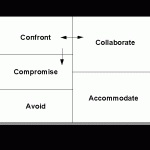
There are two practical ways to not engage (accommodate or avoid) and three others to engage, as shown below.

Strategies for Resolving Differences: 

Strategy and Theme

Avoid — “Leave well enough alone”

Accommodate — “Kill ‘em with kindness”

Confront — “Might makes right”

Collaborate — “Two heads are better than one”

Compromise — “Split the difference”

Using the earlier example of a verbal sharp stick, you can use avoidance to disengage, as in “I’m not available for this conversation right now.” Or you could constructively accommodate by refocusing only on what they’re wanting for the future with “And what do you suggest we do differently next time?”Most of us rely on one or two of the five and would benefit from practicing use of the others. What are the situations when each is the right choice?

When Not to Engage

Avoiding is appropriate when there’s no way to win or there needs to be a cooling off period.

Accommodating involves listening and accepting without resistance, effective when the issue is less important than the relationship. Accommodation on minor issues which are important to others are gestures of goodwill and are a way to make deposits in someone’s “emotional bank account.”

Not engaging is different than resisting or being defensive. It can be a conscious, deliberate choice to not struggle, to protect the relationship, or to stop adversarial, win-lose dynamics. Rather than “meeting them at their own game,” call the game over and arrange to play another day in some other way.

When to Engage

On the other hand, do you sometimes have trouble taking a firm stand, even when you see the need? That could a sign that you rely too heavily on avoiding or accommodating.

Gently confronting the other person and assert your view might sound like “I didn’t use your idea because … and how can we work it out so that you can contribute here and I still get to decide how to do my job?,” which leads to collaborating on a solution. If you find yourself often hurting other people’s feelings or stirring up hostilities, consider using the other four strategies.

Collaborating might involve working together to generate win-win alternatives to resolving the issue. If you rely too heavily on this one, you’ll spend time discussing issues in depth that do not seem to deserve it.

Compromise, used to get to quick resolution, involves bargaining and mutually giving up something to reach settlement. “If I use your idea will you stop bugging me about it?” It doesn’t really solve the core issue, but it does quickly handle part of the problem and prevents further escalation.

When you know people, and you know yourself, you’ll be able to quickly assess if you can “get there from here.” To find that balance point where boundaries are neither too rigid nor too fluid, consider varying your approach by practicing each strategy for 3-6 weeks, then they’ll be available when you need them most.

When to Negotiate Directly

Lastly, negotiation makes sense whenever you can make the other person an offer or proposal that they would find more attractive than their next-best alternative. In addition….

  • When it’s up to you, when there are no better alternatives
  • When the task or issue is important (if it’s not, either let it go or lead strongly)
  • When you’re not so fully invested in a position that you can explore options
  • When not negotiating would cost you; when you have something to gain
  • When there’s been a misunderstanding; when there is no understanding or agreement
  • When you’d like the satisfaction, peace of mind … from handling differences openly
  • To be a model: to demonstrate what effective negotiation looks/sounds/smells/feels like.

Giving Workplace Negativity a Sustainable Lift: Part 3

Ending the Blame & Shame Game — part 3 of 3

By Daniel Robin

“You did it again! How many times have I told you that it is not okay to socialize with your workers … you’re in charge here, and being seen as ‘Mr. nice guy’ undermines your authority.” The boss has spoken.

“I don’t ‘socialize’ with them … we just talk, Bob explains. “Plus, you and I go to lunch sometimes … why is that different?”

“Are you calling me a hypocrite?”

Bob’s boss, Phil, is a long-standing Blame Game champion. Just last week he told the CEO that his department’s failure to meet objectives was because the company doesn’t pay high enough wages. Hmmm. Responsibility anyone?

But rather than blaming the blamer (which requires the extended, 24-hour-a-day Family Edition of our annoying little game), how about if we find a way to help and support Bob’s boss – and people who act like him – to approach problems with a bit more tact and skill?

In most workplaces, when there’s a problem, a person or team automatically takes the heat. This article is about accepting responsibility without buying into the Blame Game.

Recognizing the Signs

The Blame Game stands in sharp contrast to (a) constructive criticism, (b) asserting a clear boundary, or (c) using skill and impartiality to solve problems or resolve breakdowns. How can you tell if someone is coming from blame and shame, delivering a message that makes wrong and puts down? Here are three telltale signs:

  1. The message and general ‘vibe’ tends to focus on what’s not wanted …. In the example above, when Phil outlaws socializing with workers, he’s focused on what he doesn’t want from Bob (weakened authority), but what does he want?
  2.  Focus on the past – and by definition, the past is entirely outside of everyone’s sphere of influence. When there’s nothing that can be done, blame and shame are a sad substitute for forgiveness.
  3.  No acknowledgement of a goal or desired result. If Bob wasn’t caught up in defending himself, he could’ve asked Phil, “So, what do you want me to do instead?”

You see, the object of the Blame Game is to confront issues so forcefully that people have no choice but to comply. Doesn’t usually work. Whenever someone is denied choice, expect resistance or long-term resentment.

Nobody likes to be put down, blamed, or criticized. Therefore, it is essential that problems get surfaced, and criticism gets delivered in a context that makes it possible for the other person to hear and use it.

Shifting from Blame to Aim

Have you ever worked with someone who can make difficult feedback easy to swallow? Some highly-skilled leaders can make a subtle character assassination feel like a birthday present. The key? No matter how bad the problem or screw-up, focus on the future – on shifting the game from Blame to Aim.

Aim Game objective: confront issues so tactfully that others naturally want to work it out. When you “complain” well, without shaming or making wrong, you refrain from the strain and pain that makes people insane (hey that almost rhymes!). Seek cooperation and understanding first, then be on the lookout for joint solutions. This not only takes less work, but also results in sustainable workplace agreements. The payoff: solutions that go deeply to the root cause and get upheld more often.